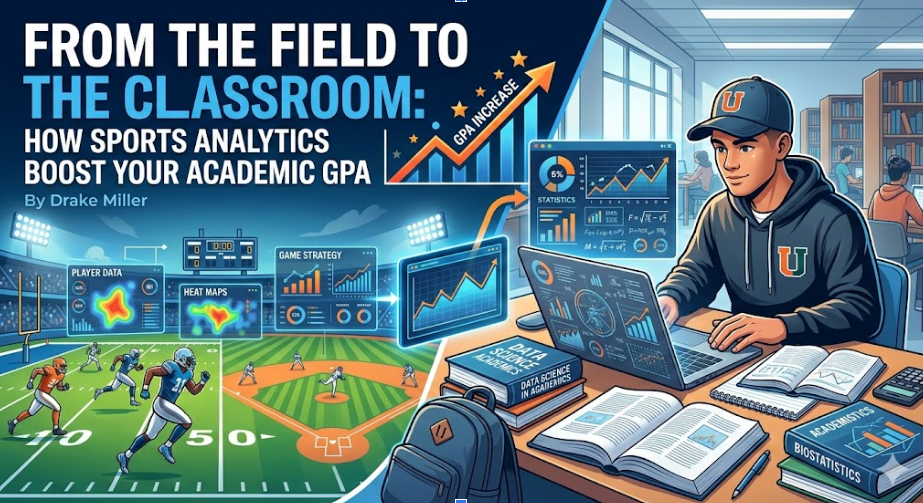
By Drake Miller
In the modern digital age, students are often told that “knowledge is power.” However, as information becomes increasingly accessible, the true power lies not in the possession of facts, but in the ability to analyze, evaluate, and synthesize them. This is the essence of critical thinking.
As someone who has spent years navigating the intersection of data science and educational development, I have observed that critical thinking manifests in some of the most popular pastimes globally—most notably, sports predictions. Whether you are trying to project the outcome of a championship game or drafting a thesis on macroeconomic trends, the cognitive processes involved are remarkably similar. For high school and college students, understanding the intersection between sports analytics and academic rigor can unlock new levels of success in both the classroom and the real world.
Defining Critical Thinking in a Competitive Context
Critical thinking is the intellectually disciplined process of actively and skillfully conceptualizing, applying, analyzing, and evaluating information. In academia, this often involves questioning a source’s bias or identifying a logical fallacy in an essay—skills that are foundational for students seeking thesis help on complex research projects. In the world of sports, it means looking past the “hype” of a star player to analyze the underlying data.
A student who can predict a sports outcome based on historical data, weather conditions, and player fatigue is using the same brain muscles required to solve a multi-variable calculus problem or interpret a complex text. Both require a departure from “gut feelings” toward evidence-based reasoning.
The Data-Driven Connection: From Statistics to Sports
One of the most direct links between sports predictions and academic success is the mastery of statistics. High school students often view math as an abstract requirement, yet when applied to sports, it becomes a living, breathing tool.
- Probability and Risk Assessment: In sports predictions, you are rarely looking for a certainty; you are looking for an edge. Evaluating the probability of a win involves understanding sample sizes and standard deviations. This is identical to the scientific method used in biology or chemistry labs.
- Identifying Patterns and Anomalies: A critical thinker in sports looks for trends. Is a team performing poorly because of a lack of skill, or is it a statistical anomaly? Similarly, in history or sociology, students must distinguish between correlation and causation.
Cognitive Biases: The Enemy of the Student and the Analyst
Perhaps the greatest lesson sports predictions teach students is the danger of cognitive bias. To succeed in academics, one must be objective. However, humans are naturally prone to biases:
- Confirmation Bias: A fan might only look at stats that favor their team, just as a researcher might only look for sources that support their thesis.
- The Gambler’s Fallacy: The belief that because a team has lost three times, they are “due” for a win.
- Availability Heuristic: Overestimating the importance of recent highlights while ignoring long-term data.
By practicing sports prediction, students become hyper-aware of these biases. When they sit down to write a research paper, they are better equipped to challenge their own assumptions. For students who find it difficult to translate these complex analytical thoughts into a structured academic format, utilizing specialized resources — such as studying thesis statement examples at Myassignmenthelp.com — can bridge the gap between raw data analysis and polished, high-scoring writing.
The Research Process: Scouting vs. Studying
To make an informed sports prediction, one must conduct “scouting,” which involves primary research, secondary research, and comparative analysis. This is a mirror image of the academic research process. A student preparing for a debate or writing a term paper must navigate the same steps: vetting sources for credibility and synthesizing conflicting viewpoints into a defensible conclusion.
Communication and Argumentation
Making a prediction is only half the battle; the other half is justifying it. Writing a persuasive sports analysis requires a clear thesis, evidence, and the acknowledgment of counter-arguments. These are the fundamental building blocks of the five-paragraph essay—the gold standard for high school and introductory college writing.
See also: Building Ethical Technology Systems
Frequently Asked Questions
Q.1 How does analyzing sports improve a student’s critical thinking?
Analyzing sports requires students to look beyond surface-level narratives. It forces them to use data-driven reasoning, evaluate variables like weather or injuries, and recognize patterns—all of which are core components of the critical thinking required in high school and college academics.
Q.2 Can sports analytics help with math and statistics grades?
Absolutely. Concepts like probability, standard deviation, and expected value (EV) are central to sports analytics. When students apply these mathematical theories to something they are passionate about, like sports, they often find the classroom material much easier to grasp.
Q.3 What is the biggest mistake students make in both sports predictions and essays?
The most common mistake is confirmation bias. In sports, fans ignore data that suggests their team might lose. In academics, students often ignore evidence that contradicts their thesis. Learning to be objective is the key to success in both fields.
Q.4 Are there professional tools to help students improve their academic writing?
Yes. Just as sports analysts use advanced software, students can use academic support services. Myassignmenthelp.com provides expert guidance to help students structure their arguments and ensure their writing reflects high-level critical analysis.
Conclusion: A Holistic Approach to Learning
The link between critical thinking in sports and academic success is not about gambling; it is about the application of logic to a complex, moving target. For high school and college students, treating sports as a subject of study rather than just a hobby provides a competitive edge in their education.
As you refine your ability to analyze the field, remember that you are also refining the skills that will carry you through your degree and into your professional career. Whether you are analyzing a point spread or a complex literary theory, excellence requires practice. For those moments when the academic workload feels as heavy as a championship season, Myassignmenthelp.com is available to ensure your written work reflects the high level of critical thinking you bring to every challenge.
About the Author
Drake Miller is an educator and data strategist specializing in cognitive development and academic performance. With a background in statistical analysis, Drake focuses on helping high school and college students bridge the gap between their extracurricular interests and their academic goals. His work explores how modern technology and data-driven logic can enhance learning outcomes in the 21st century.